Use Cases
Technical Manuals and User Guides (Engineering)
In engineering contexts, particularly when working with intricate technical manuals or detailed user guides, sentence-aware chunking aids in simplifying complex information into more digestible sections.Breaking down complex case law into simpler parts for easier interpretation and retrieval.
Training Manuals and Procedures (Manufacturing)
Training manuals and procedures in manufacturing often include essential information. Using sentence-aware chunking ensures that each procedural step is kept intact within a chunk, minimizing the risk of misinterpretation and improving clarity for operators and staff.
Content-aware Chunking Code
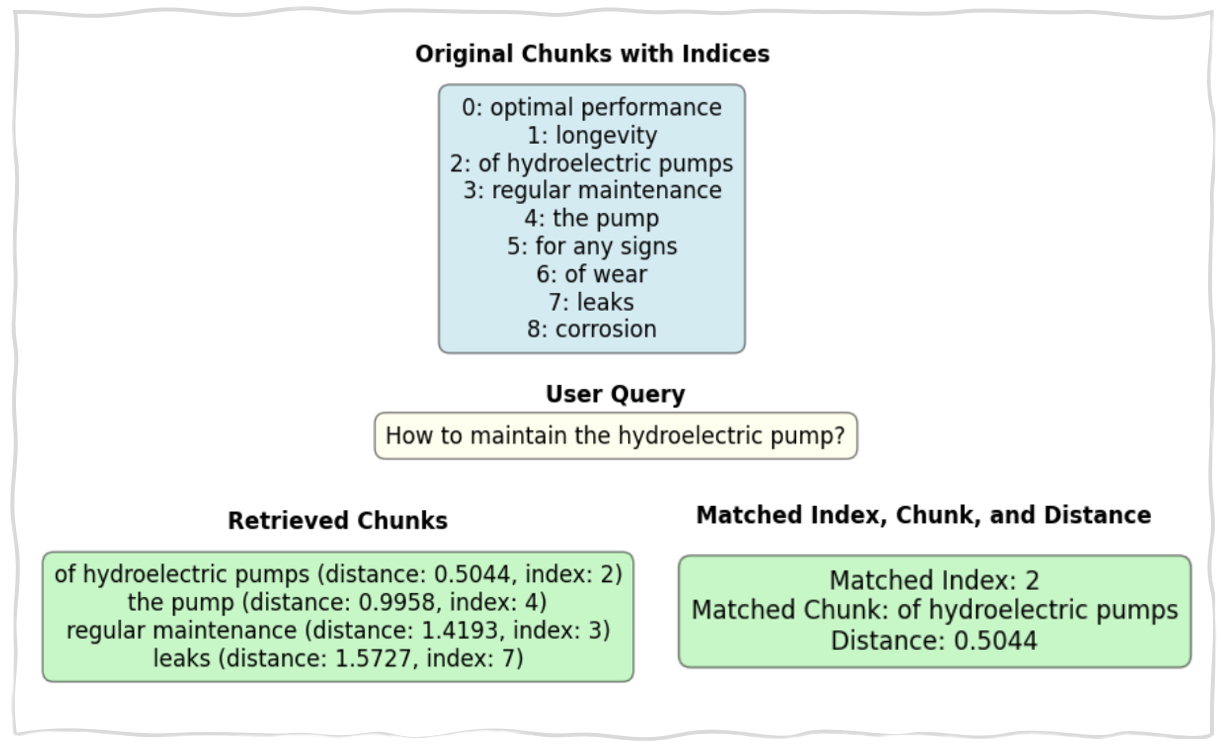
Example of Content-aware Chunking Result


Pros and Cons of Content-aware Chunking
| Pros | Cons |
|---|---|
| Offers high customizability, allowing the integration of new languages or domain-specific tokenizers. | May operate more slowly than simpler tokenizers due to its in-depth linguistic processing |
| NLTK is a well-established library with extensive documentation and strong community support. | Might not be the optimal choice for tasks that prioritize semantic context over syntactic accuracy. |
| Utilizes pre-trained models to accurately identify sentence and word boundaries, making it especially effective for linguistically complex texts. | Segments text based on syntactic rules rather than semantic meaning, which can sometimes result in a loss of context. |